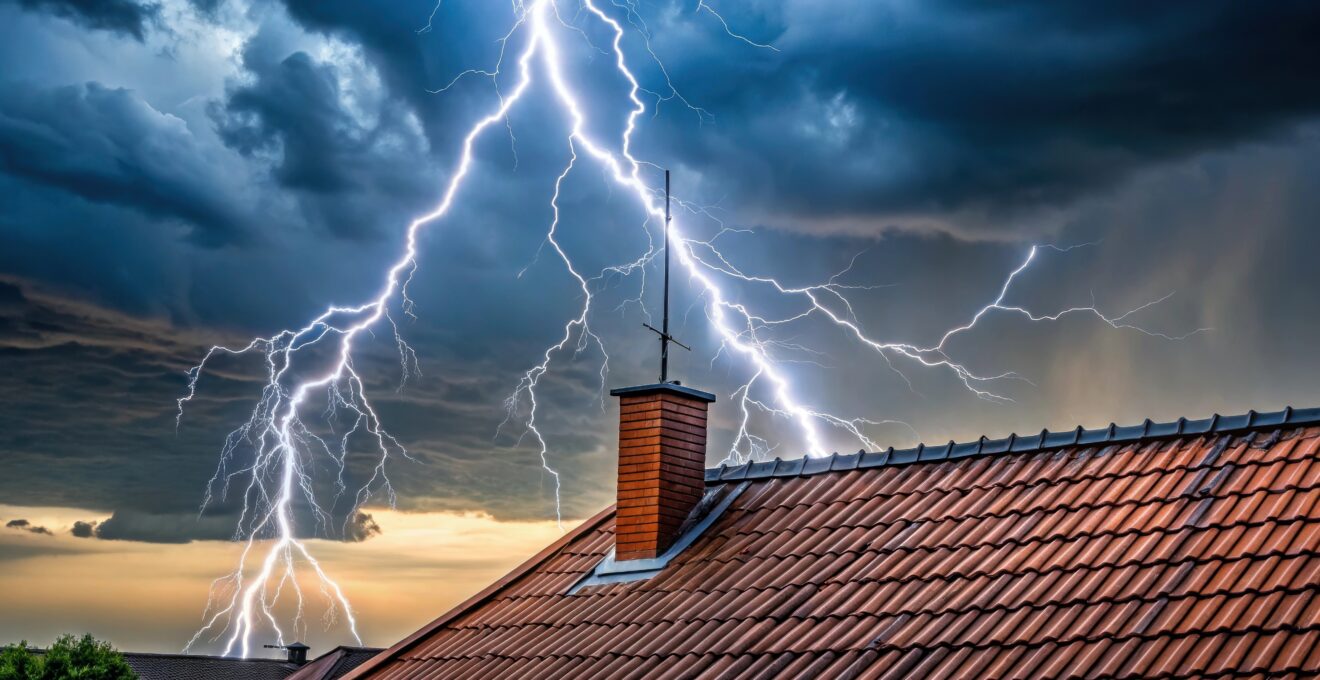
This content is provided for informational purposes. Comply with current standards and consult a certified expert before any intervention. Lightning protection system design and installation must be undertaken by competent persons in accordance with IEC 62305 and relevant national regulations.
External protection intercepts lightning strikes and channels current safely to earth via air terminals, down conductors, and earth termination networks. Internal protection prevents dangerous sparking between conductive building elements through equipotential bonding and controlled separation distances. Surge protection devices shield sensitive electronic systems from transient overvoltages induced by both direct strikes and switching events. All three function as an integrated system per BS EN 62305.
Decoding structural protection against electrical strikes
The tripartite classification exists because lightning creates multiple simultaneous hazards that require fundamentally different mitigation strategies. A lightning strike delivers peak currents exceeding 200,000 amperes in microseconds, generating extreme magnetic fields, explosive pressure waves, and voltages sufficient to arc across air gaps of several metres. Treating this solely as a roof-mounted discharge problem — the outdated « lightning rod » mentality — leaves critical vulnerabilities unaddressed.
IEC 62305 emerged from decades of incident analysis demonstrating that external air terminals successfully diverting strike current to earth could still result in catastrophic equipment destruction and personnel injury. The current’s magnetic field induces voltages in nearby conductors; differences in earth potential between bonded metalwork create dangerous sparking paths; and transient surges propagate through power and data cabling to destroy semiconductors kilometres from the strike point. Certification bodies consistently emphasize that partial implementation — installing external protection whilst omitting internal bonding or surge suppression — creates regulatory non-compliance and voids insurance coverage.
Modern standards therefore mandate an integrated systems approach. The three protection types operate in concert: external systems create a controlled current path with predictable electromagnetic behaviour, internal systems prevent that behaviour from causing secondary arcing, and surge protective devices clamp induced voltages before they reach sensitive loads. Specifying one type in isolation constitutes a fundamental misunderstanding of lightning phenomenology.
The tripartite framework: external, internal, and surge protection dissected
The functional differentiation between protection types reflects the physics of lightning interaction with structures. Each addresses a distinct failure mechanism; each requires different design calculations and installation competencies.
| Protection Type | Primary Function | Key Components | IEC 62305 Reference | Installation Complexity | Regulatory Priority |
|---|---|---|---|---|---|
| External LPS | Strike interception and safe current dissipation to earth | Air terminals, down conductors, earth termination network | BS EN 62305-3 | Moderate — structural mounting and earthing works | Mandatory for structural fire prevention |
| Internal LPS | Equipotential bonding to prevent dangerous sparking | Bonding conductors, separation distance calculations, SPDs at boundaries | BS EN 62305-3 | High — requires electrical and structural coordination | Critical in ATEX and flammable environments |
| Surge Protection (SPD) | Shield electronics from transient overvoltages | Type 1, Type 2, Type 3 SPDs in coordinated topology | BS EN 62305-4 | Moderate — electrical panel modifications required | Essential for data integrity and process continuity |
External Lightning Protection System: interception and safe current dissipation
External protection creates a preferential attachment point for the lightning leader channel and a low-impedance path to disperse the strike current into the general mass of earth. The system comprises three functional elements working in series: air termination, down conductor network, and earth termination.
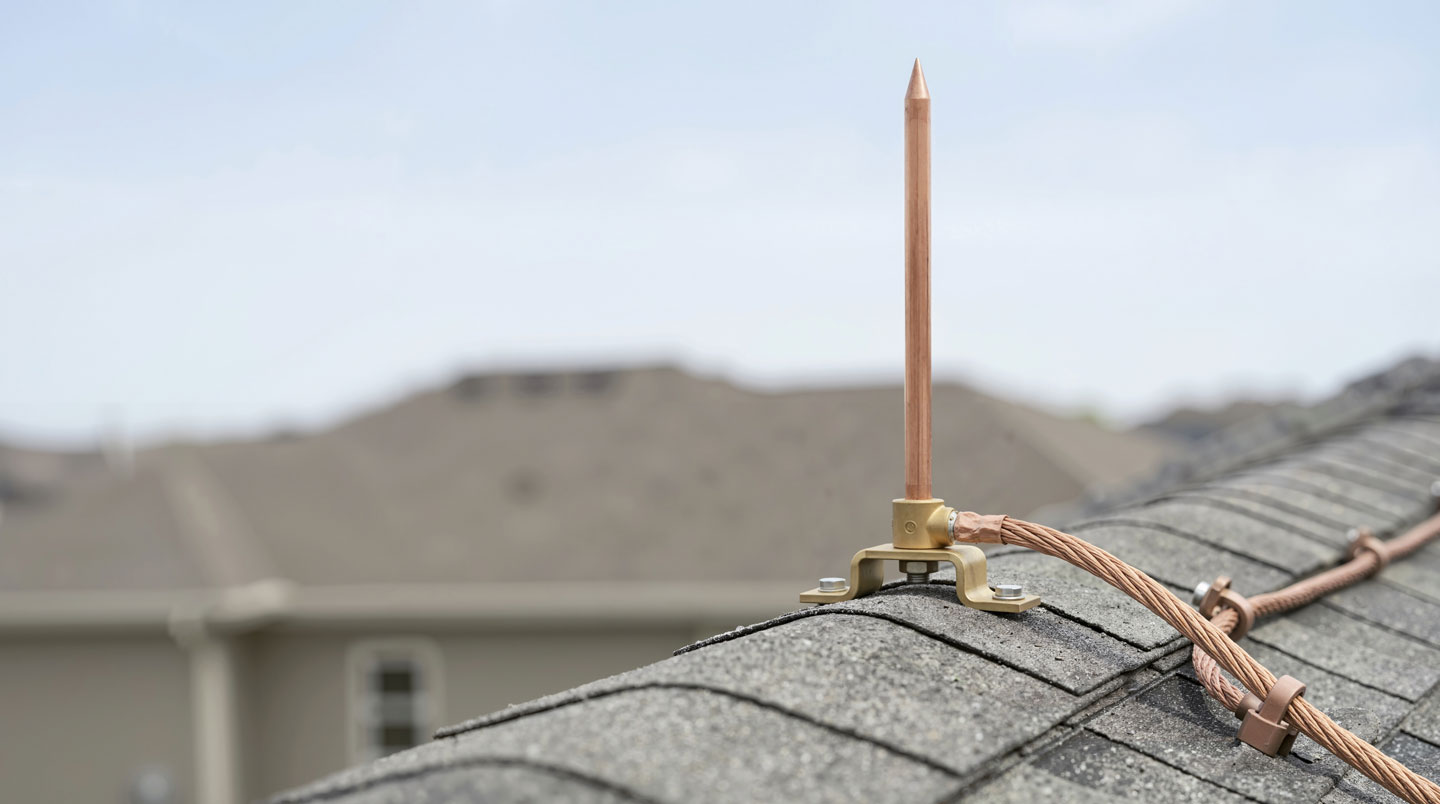
Air terminals — rods, horizontal conductors, or mesh networks — position capture points according to the rolling sphere method defined in BS EN 62305-3. Down conductors provide multiple parallel current paths descending the structure’s perimeter, with conductor spacing determined by the required Lightning Protection Level. The earth termination network, typically comprising ring conductors and vertical rods, achieves sufficiently low earth resistance (usually below 10 ohms) to prevent dangerous ground potential rise during current dissipation.
External LPS alone prevents structural fire and gross mechanical damage from direct attachment. It does not, however, address electromagnetic induction in internal wiring or prevent voltage differences between separately earthed metalwork — hence the necessity of complementary internal protection.
Internal Lightning Protection System: equipotential bonding and separation distance
Internal protection mitigates the consequences of the external system’s operation. When hundreds of kiloamperes flow through down conductors, the intense magnetic field induces voltages in parallel metal structures — pipework, cable trays, steelwork, HVAC ducting. Without deliberate intervention, these induced voltages create potential differences sufficient to cause dangerous sparking or « side-flashing » between the LPS and proximate conductive elements.
BS EN 62305-3 prescribes two complementary approaches: direct equipotential bonding of all metallic installations to the LPS at regular vertical intervals, or maintaining sufficient separation distance ‘s’ such that the voltage gradient cannot sustain an arc. The separation distance calculation depends on the Lightning Protection Level, the down conductor configuration, and the strike current amplitude — typically yielding minimum distances of 0.5 to several metres for high-risk applications.
This requirement presents particular challenges in ATEX-classified zones and chemical processing facilities where uncontrolled arcing could ignite flammable atmospheres. The Health and Safety Executive guidance on major hazard sites explicitly identifies lightning protection as integral to preventing major accidents, stating that a lightning strike at a major hazard installation can be an initiating event for a major accident, necessitating rigorous application of BS EN 62305 across all four parts.
Surge Protection Devices: shielding sensitive electronics from transient overvoltages
Whilst external and internal protection address the physics of the strike current itself, surge protective devices mitigate the secondary electromagnetic effects propagating through electrical installations. Lightning induces transient overvoltages through three mechanisms: direct injection of strike current into service lines, electromagnetic induction in cable loops, and resistive/inductive coupling between earth conductors.
BS EN 62305-4 mandates coordinated SPD installation at multiple protection boundaries. A comprehensive protection system includes all three SPD types: Type 1 installed at the electrical supply intake to handle direct strike currents, Type 2 at each distribution board to suppress conducted and induced surges, and Type 3 at the point of use for particularly sensitive electronics. Each type exhibits different energy-handling capacity and response characteristics; correct coordination ensures that upstream devices clamp high-energy transients whilst downstream devices provide fine voltage limiting.
The most commonly observed specification error involves treating surge protection as optional for facilities with robust external LPS. Industry data indicates that indirect lightning strikes routinely cause failure of data servers, heating controls, fire and intruder alarm safety systems, and building power supplies — equipment losses that external air terminals cannot prevent. For process-critical installations, SPD failure represents direct financial exposure through production downtime and unplanned maintenance interventions.
From risk assessment to system specification: matching protection to threat level
Determining which protection types apply to a specific installation — and at what performance level — requires structured risk assessment per IEC 62305-2. The methodology quantifies the probability of lightning strike to the structure, the probability of consequent damage, and the magnitude of loss (human safety, service disruption, cultural heritage). The resulting risk value dictates whether protection is mandatory, recommended, or discretionary.
Ground flash density forms the foundation of this calculation. The UK exhibits significant geographical variation in lightning activity: consolidated 2024 data from METEORAGE recorded an average density of 0.0726 cloud-to-ground flashes per square kilometre, with more than 17,000 detected lightning events nationwide. This figure sits above the long-term average of 0.0364 flashes per km² annually since 2007, demonstrating year-to-year variability that must be factored into design assumptions. For high-risk industrial facilities such as chemical processing plants, pharmaceutical manufacturing sites, and Seveso-classified operations, understanding local strike density is fundamental to accurate risk assessment. Lightning protection industries require high-resolution lightning data services that enable precise Lightning Protection Level determination and compliance with IEC 62305-2 methodology.
Consider a pharmaceutical manufacturing facility in the Midlands with a footprint of 2,500 m² and height of 12 metres, housing flammable solvents and employing 45 personnel. Using the 2024 ground flash density of 0.0726 flashes/km² for the UK, the IEC 62305-2 risk calculation accounts for the structure’s collection area, occupancy hours, and consequence factors for both life safety (R1) and service continuity (R2). The presence of ATEX-classified zones elevates consequence parameters, typically driving the assessment toward Lightning Protection Level I or II requirement. This mandates full three-tier protection: external LPS with rolling sphere radius ≤20m for LPL I, continuous equipotential bonding of all process vessels and pipework, and coordinated Type 1/2/3 SPD deployment protecting both power distribution and critical process control networks.
The risk assessment yields selection of Lightning Protection Level (LPL I through IV), which in turn determines the design parameters for all three protection types: rolling sphere radius for air terminal placement, maximum down conductor spacing, separation distance ‘s’, and SPD coordination requirements. High-consequence sites typically mandate LPL I or II, requiring the most stringent protection measures across external, internal, and surge domains.
- If structure houses explosive atmospheres, critical infrastructure, or assemblies >100 persons:
Full three-tier LPS mandatory (external + internal + coordinated SPD network). Risk assessment drives LPL selection; typically LPL I or II required. Professional design and third-party certification non-negotiable.
- If structure contains sensitive electronic systems but moderate occupancy:
External protection plus Type 1 and Type 2 SPD coordination often sufficient. Internal bonding required where separation distance cannot be maintained. LPL II or III typical.
- If agricultural building, minimal occupancy, no flammable materials:
External LPS alone may meet regulatory threshold. Formal risk assessment under IEC 62305-2 determines whether protection is discretionary. Insurance requirements frequently override minimum compliance.
Attention: COMAH-regulated facilities, Seveso sites, nuclear installations, and defence infrastructure face enhanced lightning protection requirements beyond basic structural safety. Inadequate protection constitutes a Major Accident Hazard under process safety regulations. Installation must be performed by BAFE-registered specialists or chartered electrical engineers; self-certification is not permitted for these classifications.
Navigating IEC 62305 and UK compliance: standards, certification, and ongoing obligations
BS EN 62305 represents the British Standards Institution’s adoption of the international IEC framework, maintaining technical equivalence whilst incorporating UK-specific regulatory cross-references. The standard comprises four parts: Part 1 establishes general principles and terminology; Part 2 defines risk management methodology; Part 3 addresses physical damage to structures and life hazard (corresponding to external and internal protection); Part 4 covers electrical and electronic systems within structures (surge protection domain).
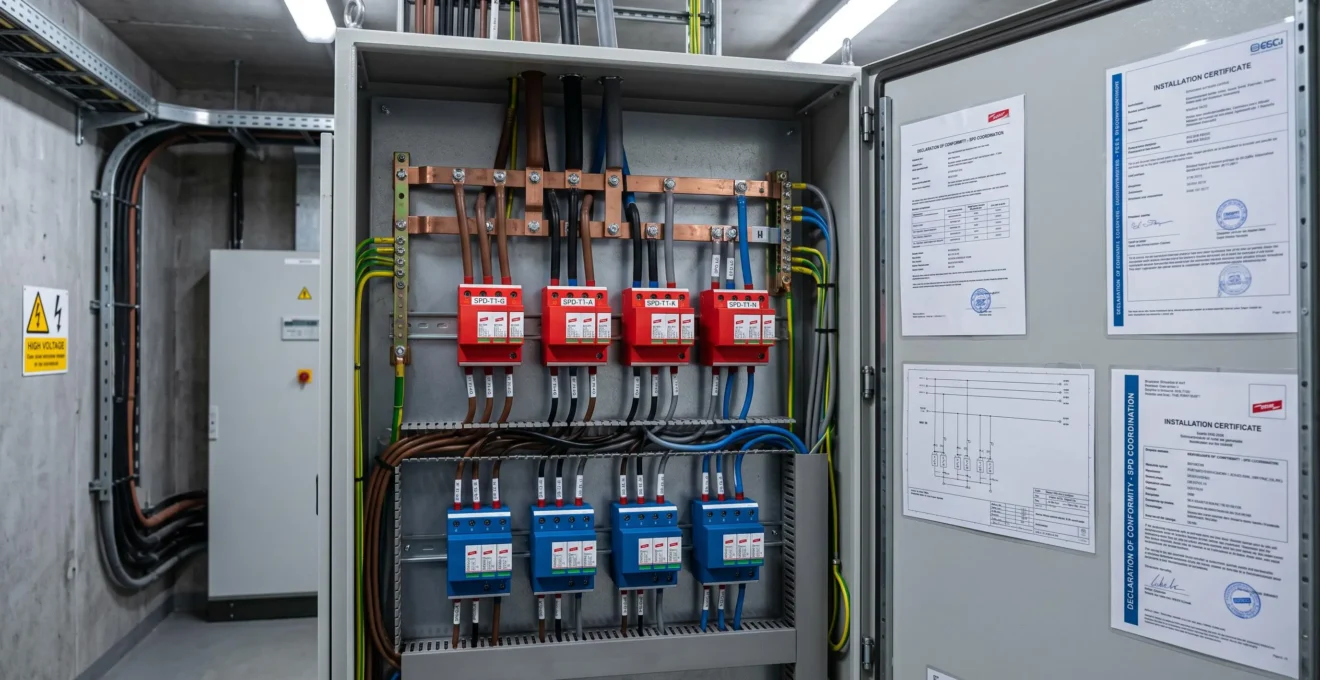
UK Building Regulations Approved Document B mandates lightning protection for structures exceeding certain height thresholds and those presenting special fire risks. Compliance requires that all three LPS types be designed, installed, and certified as an integrated system; partial implementation invalidates certification. Installation must be undertaken by competent persons — typically interpreted as BAFE-registered firms, chartered electrical engineers, or contractors working to third-party-approved designs.
Certification involves design review, installation inspection, and commissioning testing (earth resistance measurement, continuity verification, separation distance validation). Periodic re-inspection is mandatory, with intervals determined by risk classification — annually for high-consequence sites, up to four years for lower-risk installations. Practitioners navigating IEC 62305 compliance frequently encounter pitfalls in regulatory standards such as misinterpreting risk matrix thresholds or overlooking updates to normative annexes.
Bon à savoir: BS EN 62305 series structure: Part 1 establishes general principles and definitions. Part 2 provides risk management methodology and LPL selection. Part 3 specifies protection against physical damage and life hazard (external and internal protection). Part 4 addresses protection of electrical and electronic systems (surge protection). All four parts must be applied coherently; selective compliance is not permissible.
Insurance underwriters increasingly mandate third-party certification as a condition of coverage for high-value or process-critical facilities. Non-compliance may void claims and expose facility operators to liability in the event of lightning-related incidents. Regulatory enforcement by HSE or local authorities can result in improvement notices and operational restrictions where protection is deemed inadequate.
Frequently asked questions on LPS classification and implementation
Can external protection be installed without internal bonding or surge devices?
External-only installation fails to meet BS EN 62305 requirements for comprehensive protection. Whilst not creating additional hazard, it leaves electromagnetic induction and earth potential rise unmitigated — creating false security and invalidating certification. For buildings containing any electrical systems, coordinated SPD installation is essential; for structures with extensive metalwork or process equipment, internal bonding prevents dangerous side-flashing.
How frequently must lightning protection systems be inspected and tested?
Inspection intervals depend on risk classification and insurance requirements. High-consequence sites (COMAH, hospitals, data centres) typically require annual inspection. Commercial and industrial buildings with LPL II or III protection may extend to two-year intervals. Low-risk structures can adopt four-year cycles. All inspections must verify earth resistance, conductor continuity, and SPD operational status, documented by competent persons.
Do rooftop solar photovoltaic installations affect lightning protection design?
Solar arrays introduce additional strike attachment points and extensive conductive surfaces requiring integration into the LPS. Mounting frames must be bonded to the external protection network; inverters and DC cabling require dedicated surge protection per IEC 62305-4 Annex E. Retrospective solar installation on protected structures necessitates LPS re-assessment and often requires additional down conductors or air terminals to maintain protection integrity.
What is the expected service life of surge protective devices?
SPD lifespan varies with exposure to transient events and inherent component degradation. Type 1 devices in high-lightning-density regions may require replacement after 10–15 years; Type 2 and Type 3 devices typically achieve 15–20 years. Modern SPDs incorporate end-of-life indication (visual flags or remote contacts) signalling when replacement is necessary. Devices that have conducted direct strike energy should be inspected immediately and replaced if degradation indicators activate.
Are there cost-effective approaches for small commercial buildings?
Risk-based design under IEC 62305-2 may demonstrate that simplified protection meets regulatory thresholds for low-occupancy, non-hazardous buildings. External mesh conductor systems integrated into roof construction during new-build prove more economical than retrofitted rod-and-wire installations. Coordinated Type 1 and Type 2 SPD installation at main and sub-distribution boards provides cost-effective surge protection without extensive point-of-use Type 3 deployment. Professional risk assessment prevents both over-specification and dangerous under-protection.
For organizations managing both lightning protection compliance and broader infrastructure standards such as data security for control systems, integrated approaches to meeting industry standards can improve efficiency and reduce audit burden across multiple regulatory frameworks.
The three-tier framework exists because lightning phenomenology demands multi-modal protection. External systems alone leave electronic equipment vulnerable; surge protection without external interception cannot prevent structural fires; internal bonding becomes meaningless without controlled strike current paths. Treating these as alternatives rather than complementary layers constitutes the most prevalent specification error observed across both new construction and retrofit projects.
Regulatory trends across European jurisdictions indicate increasing enforcement of IEC 62305 compliance, particularly for sites presenting Major Accident Hazard potential. The integration of lightning protection requirements into broader process safety management systems — rather than treating LPS as isolated electrical infrastructure — represents current best practice for high-consequence facilities.
Accurate ground flash density data, professional risk assessment, and coordinated installation across all three protection types provide the foundation for defensible compliance. The technology exists and the normative framework is mature; implementation failures typically stem from cost-driven omissions or misunderstanding of the interdependencies between external, internal, and surge protection domains.
This guide provides general information on LPS classification and does not constitute engineering specifications for your specific site. Lightning risk assessment and system design require site-specific calculations based on structure geometry, local ground flash density, and occupancy factors as defined in IEC 62305-2. Installation must be performed by competent persons holding relevant certifications and in compliance with BS EN 62305 and Building Regulations Approved Document B. Certification, testing, and periodic inspection by accredited bodies are mandatory to validate system performance and maintain insurance coverage.
Installing an incorrect system type or omitting required components may leave structures unprotected, voiding insurance and exposing occupants to electrocution or fire hazards. Non-compliance with IEC 62305 may result in regulatory enforcement action, liability claims, and inability to obtain occupancy permits. DIY or unqualified installation can create new hazards, including incorrect earthing configurations that increase touch voltage risks.
Consult a chartered electrical engineer, certified lightning protection specialist, or accredited inspection body (e.g., BAFE-registered firms in the UK) for design, installation, and certification.